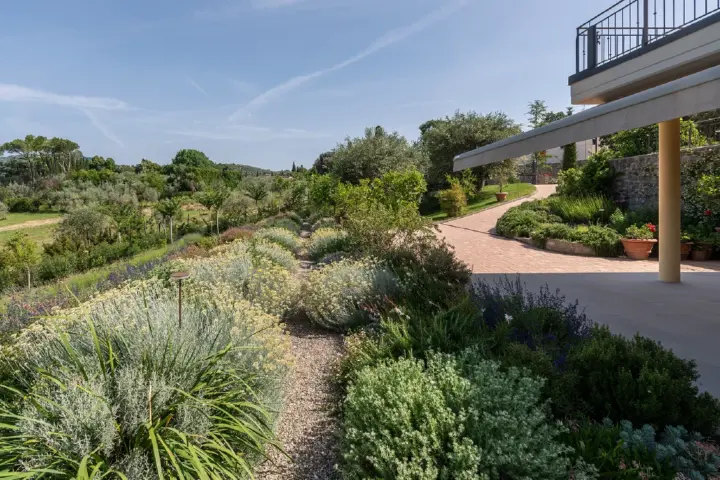

A Japanese Garden in Tuscany
A Japanese Garden in Tuscany

Overview of the Japanese Garden

Maple and bonsai

Dry stone wall. Preserving the Japanese atmosphere with Tuscan materials.

Detail of the walkway in typical Japanese style.

Stone walkway on gravel with Zen fountain.

The Japanese maple creates large shaded areas in the garden.

Glimpse of the Japanese garden.
Location:
Bivigliano (Firenze)
Year of completion:
2018 – 2021
Project by:
Dimensione Verde
Services provided:
Description:
In the hills surrounding Florence, where winters can be particularly harsh and snowfall is not uncommon, this private residence is set within a small landscape conceived as a place of contemplation and harmony. Carried out by our in-house design studio and begun in 2017, the project responded to the owners’ wish for a space with a strong Zen character, leading us to interpret Japanese landscape aesthetics and philosophy in a way suited to the conditions of the Tuscan hills.
The planting selection required careful study to identify species capable of evoking an Eastern atmosphere while remaining compatible with winter temperatures, soil conditions and the local environment. A small number of specimen trees, selected for their ornamental value and elegance of form, become the protagonists of the composition.
Despite its intimate scale, we organised the space as a sequence of small settings, each with its own identity and references to the Japanese landscape tradition. The sequence guides the eye and suggests a journey of discovery, alternating open views with more intimate corners. High-quality paving and furnishings engage with the planting through essential forms and carefully balanced combinations.
Every element plays a precise role in a balance between compositional simplicity and refinement of detail. The result is a contemplative landscape that embraces Eastern references while retaining a deep connection with the Tuscan territory and the identity of the place.